Aurora, CO –
Artificial intelligence (AI) will continue to revolutionize how the National Reconnaissance Office delivers the space-based capabilities that are critical to national security, NRO Director Chris Scolese said at an industry conference Wednesday.
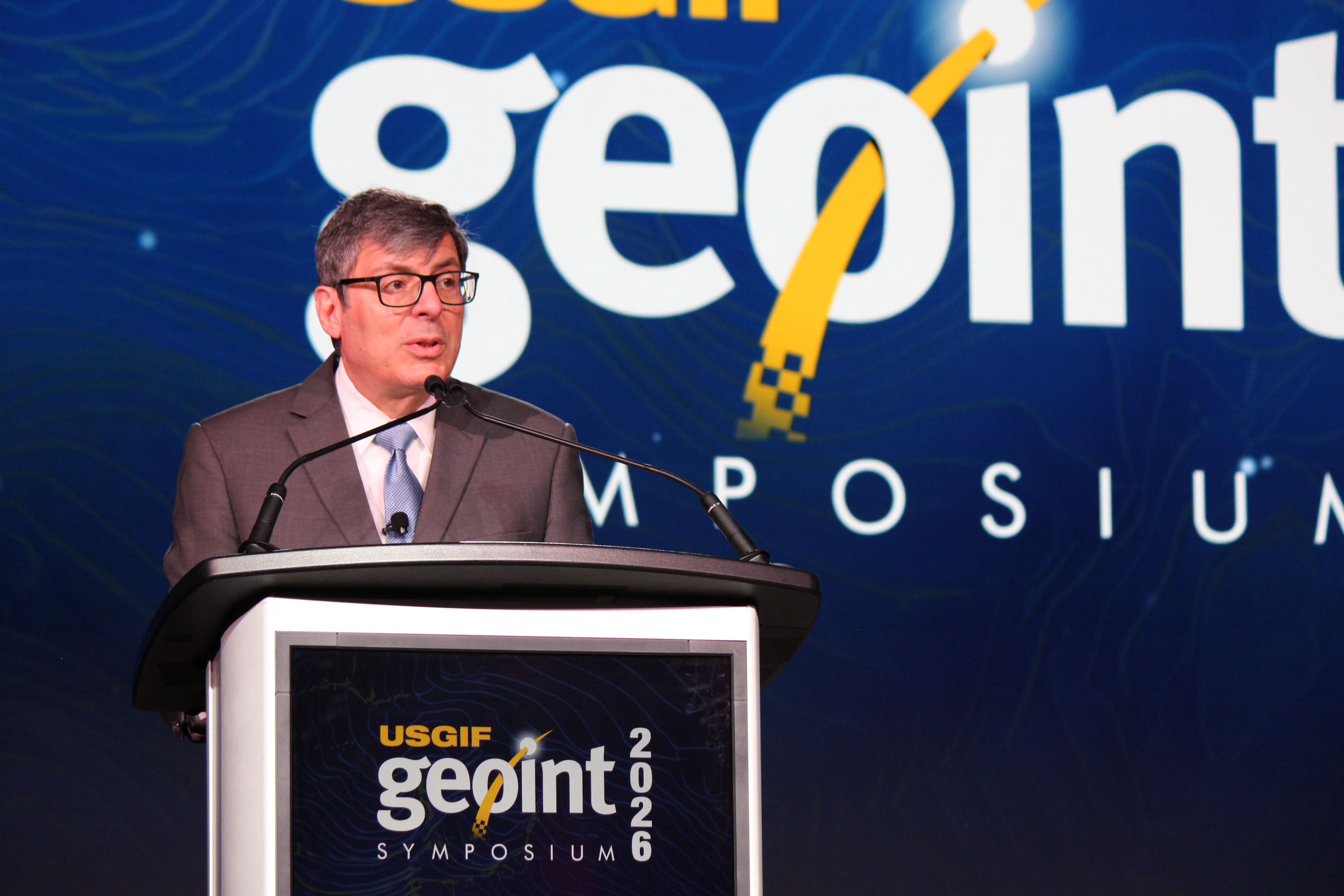
“Simply put, we must continue to leverage AI – and every emerging technology that we can – to maintain the U.S. space-based intelligence advantage as we protect our satellites; enhance our ability to monitor adversary activity; and provide timely, accurate intelligence to warfighters, analysts, first responders, and decision makers,” he said during his keynote address to the GEOINT Symposium.
Throughout its nearly 65-year history, the NRO has been developing and applying leading-edge technologies in space and on the ground to provide new capabilities, greater resiliency, and improved user experiences that aim to solve some of the United States’ most pressing intelligence challenges. Over the last several years, the NRO has been undergoing a major transformation, improving the accuracy and speed of its collections through the proliferation and diversification of its systems, including adding more than 200 satellites of diverse sizes and capabilities. Such growth will exceed the capacity of what human operators can effectively manage, making the expansion of AI imperative to NRO operations.
“Every application of AI is oriented toward faster delivery of capability, greater accuracy, and the extension of human capabilities,” Dr. Scolese said.
For example, the NRO is applying AI capabilities to increase autonomy on the spacecraft, enabling on-board processing and real-time recognition for situational response. AI can simplify the tasking process and optimize mission planning across the constellation – making it conversational rather than complex. And it can increase the discoverability of data while making it easily understood by users, even in high-pressure situations.
As AI capabilities improve and are integrated into more applications, Dr. Scolese noted that the NRO is committed to building trust and transparency into every AI system. This includes rigorous testing and validation, continuous monitoring for performance issues, and clear documentation of how each system was developed.
“As we continue to operationalize AI and incorporate AI models into essential NRO functions, we need to be able to look inside the ‘black box’ of AI and verify the prediction and outputs of a model are correct, and understand how the model arrived at its prediction,” Dr. Scolese said. “This is essential for maintaining trust in the NRO’s data.”
Dr. Scolese underscored that the NRO’s AI transformation does not mean it is seeking to replace humans with machines. Rather, one of his key priorities is developing an AI-ready workforce.
“Today, AI capabilities aren’t just being applied to our satellite systems and ground systems; they’re being integrated across our enterprise in every mission portfolio – precisely to enable our team and our partners to do things better and faster.”
To read Dr. Scolese's full remarks as prepared for delivery, click here.